
Monte Carlo Simulation Instead of an Annual Budget: Financial Modeling in the Fog of War
Monte Carlo Instead of an Annual Budget: Financial Modeling in the Fog of War
Abstract
In 2025, Ukrainian businesses operate in conditions that classical management theory defines as “extreme uncertainty.” Traditional deterministic budgeting methods (Static Budgeting), built on linear extrapolation of historical data, demonstrate critical inadequacy. Forecast error for EBITDA in static models of Ukrainian companies in 2024 reached 40–60%. This report proposes a shift to probabilistic (stochastic) planning using Monte Carlo simulations. The document contains macroeconomic analysis for 2025–2026, a mathematical rationale for distribution selection, practical cases from real companies, and an implementation methodology.
Why the annual budget no longer works?
December 2024 became a point of no return for many CFOs. In negotiation rooms—often lit only by the glow of generators—the ritual of approving the annual budget played out with pedantic precision: an exchange rate of 44.5 UAH, inflation of 9.7%, payroll growth of 14%—and these figures turned into directive KPIs and the foundation of bonus schemes.
The horizon of reliable planning collapsed to the operational week, and baseline assumptions can be wiped out in a matter of hours.
When the National Bank of Ukraine misses its inflation forecast by 50% (8.4% forecast at the beginning of 2025 vs. 15.9% actual in May), when blackouts last 4–12 hours per day, when 74% of employers cannot find staff—traditional static budgeting loses its meaning. It masks critical liquidity risks and leaves the company defenseless in the face of a cash gap when a negative scenario materializes. A static budget that fixes a single future scenario masks critical liquidity risks, lulls management vigilance with “green” zones in plan-vs-actual analysis during calm periods, and leaves the company defenseless in the face of a cash gap when a negative scenario materializes.
Six variables that broke the budget
| Variable | Assumed | Actual | Error |
|---|---|---|---|
| USD/UAH exchange rate | 38.0 (early 2024) | 42.39 (end of 2025) | 12% |
| 2025 inflation | 8.4% (NBU forecast) | 15.9% (May peak) | 89% |
| Operating hours | 24/7 | 8–16 hours (blackouts) | -33% to -67% |
| Payroll growth | +5–7% indexation | +14.4% actual | 2x |
| Staff shortage | 55% (autumn 2023) | 74% (2025) | 35% |
| Generation losses | Partial | ~9 GW (one third) | Critical |
Sources: NBU Inflation Report, EBA, IEA, World Bank RDNA4
“Underlying price pressure remained persistent due to businesses’ high costs for wages and energy resources” — Andriy Pyshnyy, Governor of the NBU, October 2025.
Factors that break budgeting math
Currency volatility
In Ukraine, the exchange rate has ceased to be purely a macroeconomic indicator and has become a function of aid flows, the military-political situation, NBU interventions, and market expectations. For corporate treasuries, this means: the “anchor” is gone; the rate drifts with the regulator smoothing—but not fixing—the trajectory. Exchange-rate path: 29.25 → 36.57 → 38.02 → 42.00+ UAH/USD. Forecasts for 2026 point to drift toward 45.0 and higher. Market expectations fluctuate in the 43.7–45.0 UAH/$ range, creating a 3–5% “fork” in margin. During turbulent periods, the spread between the official rate and the cash market reached 28%. The key budget risk is not the devaluation trend itself, but the unpredictability of its pace and the timing of acceleration. During turbulent periods, the gap between the official and market rates reached 28%, creating transaction costs and hidden risks for companies with cash currency and complex settlements.
Energy deficit
Energy has turned into a key probabilistic variable of business survival. It hits the model not only through revenue, but through an explosive, non-linear increase in cost of goods sold. Generation losses of ~9 GW—one third of pre-war consumption. 100% of DTEK thermal power plants destroyed. Deficit forecast for the 2025–2026 heating season: 4–6 GW. The “cost of continuity” is critical here: generators, fuel, and infrastructure repairs have become a permanent cost line and are explicitly cited by the NBU as a factor restraining disinflation. Cost non-linearity: 1 kWh from the grid: 7–9 UAH (excl. VAT) vs. 1 kWh from a generator: 20–30 UAH. Once blackout duration exceeds battery capacity, the cost of energy provision rises 3–4x.
Talent shortage
According to the EBA, 74% of employers report an acute staff shortage. Real wages increased by 14.4% in 2024. Mobilization risk is binary: losing a key employee can mean a full stop of a business line for 3–6 months. The shortage—amplified by migration (about 6.7 million Ukrainians abroad) and mobilization—triggers a wage race: real wages in 2024 rose by 14.4%. Indexation to official inflation no longer retains people.
Why does a profitable P&L often end in a cash gap?
A profitable P&L ends in a cash gap because war amplifies the mismatch between “deal economics” and “time value of money.” The budget fixes margin and expenses, but underestimates time: receivables, “stuck” inventory, and the speed of mandatory payments growth when prices jump. A typical 2025–2026 chain: outages → output drop → missed deadlines → delayed payment → supplier prepayment due to their risk. On paper, margin “holds,” but cash conversion turns negative.
Why has the 13-week cash flow become the basic liquidity management format?
Thirteen weeks is the horizon on which a CFO can still influence operating levers: receivables, payment schedules, procurement, shift patterns, pricing, and short-term capex. An annual budget is too long for shock management, while a weekly horizon is too short to see risk accumulation. In war-mode, 13 weeks is also the horizon for conversations with banks and suppliers: limits, covenants, prepayments, and deferrals. That is why Monte Carlo on top of a 13-week cash flow provides a “combat” risk radar, not a report “for presentation.”
Monte Carlo for CFOs: a simple approach instead of fortune-telling with three scenarios
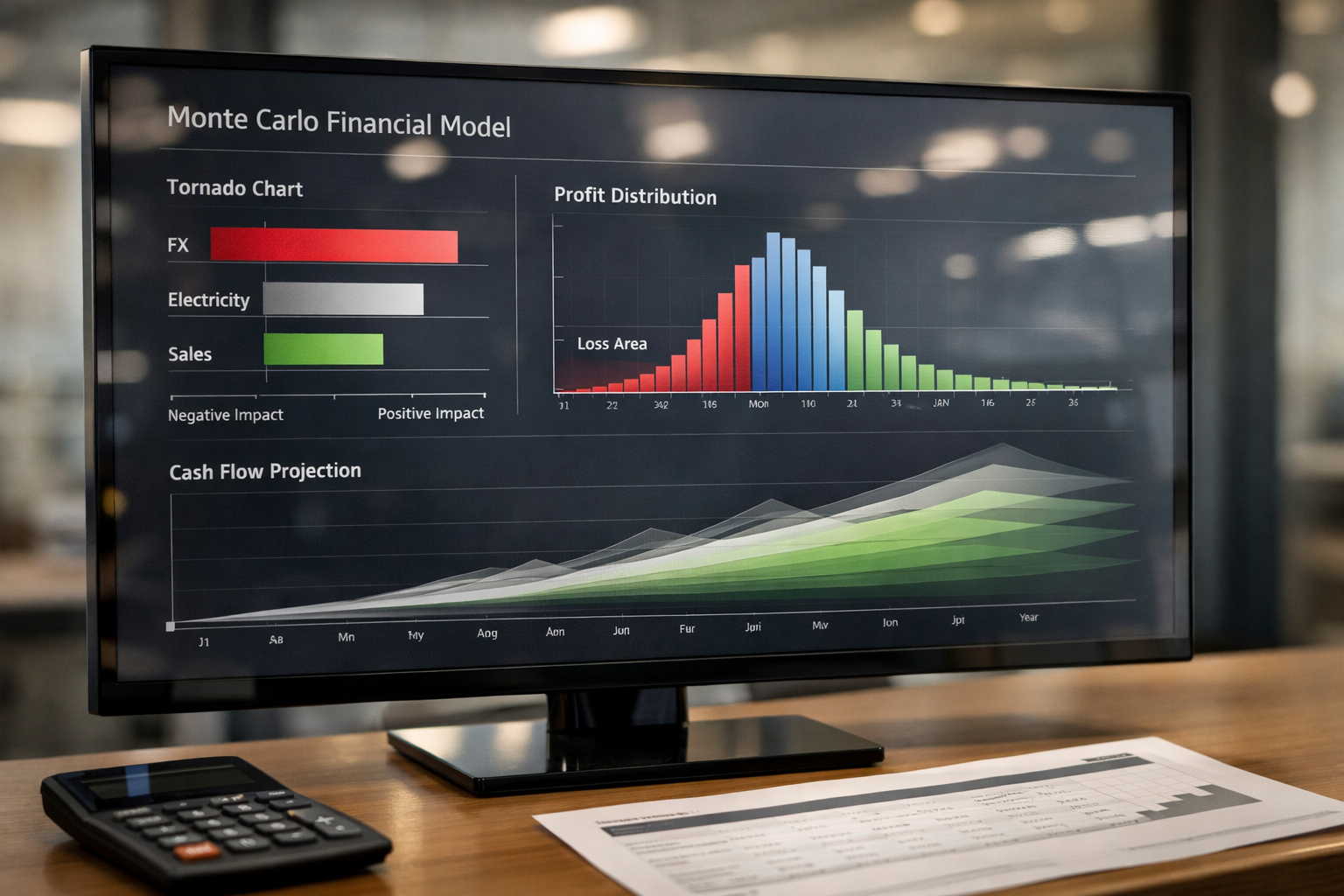
The Monte Carlo method sounds like something complex from higher mathematics, but its essence is brilliantly simple. Imagine that instead of forecasting a company’s profit once, you live the next year 10,000 times in virtual reality. In one “life,” the dollar exchange rate rose, but electricity was stable. In another, the rate fell, but the warehouse was hit. In the third, everything is bad. In the fourth, everything is perfect. The Monte Carlo method is a computational algorithm that models thousands of possible scenarios by substituting random values drawn from specified distributions for uncertain factors, to show the probability distribution of the final result. In essence: Monte Carlo is a numerical simulation method that allows you to compute the distribution of an output Y based on uncertain inputs X.
From the atomic bomb to EBITDA
The method was born in the 1940s in Los Alamos. Stanislaw Ulam and John von Neumann worked on the Manhattan Project (development of nuclear weapons). Their task was to calculate the average distance neutrons travel through different materials. The formulas were too complex. Ulam, who was ill at the time and played solitaire, thought: “What’s easier—calculating the probability that a solitaire game will succeed theoretically, or just playing it 100 times and counting the outcomes?” And Ulam proposed: let’s simulate thousands of trajectories at random and look at the distribution of results.
In 1964, David Hertz published an article in Harvard Business Review and introduced the method into corporate finance. Today, according to McKinsey, 90% of CFOs in global companies use scenario modeling in crisis conditions—data based on the outcomes of COVID-19. In business finance, it became the standard where the cost of error is high: risk management, project valuation, liquidity management, and credit covenants.
Importantly, Monte Carlo is not a replacement for management accounting, but a layer on top of it. Accounting provides the P&L/CF/BS structure and drivers, while simulation answers the risk question: “What happens to these statements under different combinations of shocks?”
Thus, physics gave finance a powerful tool. Instead of asking, “What will EBITDA be?”, we start asking, “What is the probability that EBITDA will be below zero?”
A fundamental shift in thinking
Recall Sam Savage’s book The Flaw of Averages. His classic example: “If you try to cross a river whose average depth is 1 meter, you will drown.” Because somewhere the depth is 10 cm, and somewhere it is 3 meters.
Ukrainian business is now trying to cross a raging river. A budget built on averages (average exchange rate, average sales, average downtime) will inevitably drown a company in a cash-gap pit that the “average” smoothed out. Monte Carlo shows you the riverbed relief.
Business analogy
Imagine that before approving the annual plan you have a unique opportunity to live through 2025 10,000 times in parallel universes. In one universe, the dollar exchange rate stayed at 42.0, the winter was warm, but your main competitor dumped prices. In another universe, the rate soared to 48.0, severe blackouts began, logistics stopped for a month, but demand for your product surged due to importers leaving.
After running these 10,000 virtual “lives,” we do not get a single answer like “Profit will be UAH 10 million.” We get something far more valuable—a probability map: “In 80% of universes we make a profit. In 15% of universes we incur losses. In 5% of universes we face a cash gap and go bankrupt. To survive in 95% of scenarios, we must have a liquidity reserve of UAH 6 million.”
The point: instead of one forecast “revenue = UAH 100 million,” you get a distribution: “with 50% probability revenue is above 95 million; with 90% probability it is above 82 million.”
How is Monte Carlo different from “three scenarios”?
Scenarios are a few pre-invented “stories.” Simulation is a space of possible combinations, including rare and unpleasant ones that three scenarios do not capture.
In scenario analysis, correlations are often ignored. In Monte Carlo, correlations are set explicitly—making it visible how the same shock hits multiple statement lines and amplifies damage.
Comparison of planning methods
| Method | Limitation | Monte Carlo advantage |
|---|---|---|
| Scenario analysis (best/base/worst) | 3–5 scenarios without weights | Thousands of scenarios weighted by probability |
| Sensitivity analysis | One variable at a time | All variables simultaneously with correlations |
| Deterministic forecast | Point estimate masks risk | Reveals the range of outcomes |
Why is deterministic budgeting mathematically wrong?
The Flaw of Averages
The central problem of deterministic budgeting under high volatility is described by a mathematical phenomenon known as Jensen’s inequality, or the “Flaw of Averages.” The essence of the postulate: the function of the mean of a random variable is not equal to the mean of the function of that variable.
Average profit is not equal to profit under average conditions. If you build a budget on an “average exchange rate” and “average power outages,” you systematically overestimate the financial result because the negative impact of extreme values (shocks) is disproportionately greater than the positive impact of calm periods.
Practical example
Imagine you plan a budget for generator fuel:
Scenario A (summer, no strikes): 0 hours of generator operation per day
Scenario B (winter, attacks on substations): 10 hours of generator operation per day
Arithmetic average: 5 hours per day
The company’s batteries cover the first 4 hours of outages (cost ~0 UAH). The generator turns on only from the 5th hour.
At 0 hours (Summer): cost 0
At 5 hours (Average): generator runs 1 hour
At 10 hours (Winter): generator runs 6 hours
The real average generator runtime equals (0 + 6) / 2 = 3 hours. A budget built on the average outage duration (5 hours) assumes the generator runs only 1 hour. Result: the static budget understates actual costs by 3x.
This is the classic non-linearity trap that 90% of companies fall into when using averages in budgeting. In wartime, where most risks (energy, logistics, penalties) have thresholds and non-linear consequences, using averages inevitably leads to underestimating losses.
Risk vs. Uncertainty: navigating Knight
In his foundational work Risk, Uncertainty, and Profit (1921), economist Frank Hyneman Knight introduced a distinction:
Risk: a situation where future outcomes are unknown, but the probability distribution is known (e.g., a coin toss, roulette). Risk can be insured or priced.
Uncertainty (Knightian Uncertainty): a situation where not only outcomes are unknown, but their probabilities are unknown as well (e.g., the start of a war, revolutionary innovations).
A traditional budget ignores both, pretending the future is deterministic. The Monte Carlo method allows a CFO to translate Knightian uncertainty into the plane of manageable risk—forcing management to articulate assumptions about plausible ranges (“We do not know exactly what inflation will be, but we are 90% confident it will be between 8% and 16%”), making uncertainty visible, discussable, and manageable.
Which variables should be modeled?
For Ukrainian business in 2025–2026, the key uncertainty drivers (confirmed by official sources—NBU, OECD, World Bank) are: exchange rates, inflation/costs, energy deficit (regimes), risk of staff loss, and logistics delays. It is important to choose drivers so that the model remains manageable: “2–3 variables” yield first insights faster than a perfect model with “50 factors.”
1. Exchange rate (USD/UAH, EUR/UAH)
Distribution type: Lognormal
The exchange rate has an asymmetric risk profile: theoretically unbounded upward (devaluation can reach any value, e.g., 2014–2015), but bounded downward (it cannot be negative and is unlikely to fall below an NBU support level). A lognormal distribution describes such asymmetry well, with a “long right tail.”
Parameters: Mean (expected rate, e.g., consensus forecast 44.5), Standard Deviation (historical volatility over the last 12–24 months).
2. Inflation and cost base
Distribution type: PERT (Beta-PERT)
When historical data is broken by war, it is better to rely on expert estimates. PERT distribution, developed for complex project management (Polaris), allows you to set three intuitive points: optimistic (Min), most likely (Mode), and pessimistic (Max). Unlike a simple triangular distribution, PERT puts more weight on the central tendency while correctly accounting for extremes.
Example: Inflation Min 6%, Mode 9%, Max 15%.
3. Energy deficit (hours on generator)
Distribution type: custom discrete or mixture distributions (Mixture Distribution)
The energy-supply regime is not a continuous random variable; it switches between “regimes” (Regime Switching). It is reasonable to model two system states:
“Quiet” regime: probability 70%. Outages 0–4 hours (covered by batteries)
“Stress” regime: probability 30% (winter, attacks). Outages 8–16 hours (generators)
4. Risk of staff loss / mobilization
Distribution type: Bernoulli or Binomial
For a specific key position, it is a binary event: the employee either works (1) or is mobilized/resigns (0). It cannot be modeled as “a 10% efficiency drop.”
Example: Probability of losing the chief technologist p = 15%. If the event occurs, line productivity drops by 100% for 3 months (replacement search).
5. Logistics delays (Lead Time)
Distribution type: Gamma or Weibull
Logistics processes have a hard left bound (it is technologically impossible to deliver instantly; there is a minimum travel time) and a very long right tail (cargo can get stuck at the border for weeks due to blockades or bureaucracy). The gamma distribution accurately describes queues and waiting-time processes.
Practical distribution table
| Variable | Distribution | Why | Source |
|---|---|---|---|
| USD/UAH exchange rate | Lognormal | Cannot be <0, right-skewed | NBU historical volatility |
| Inflation | PERT | Limited data, clear bounds | Min/Max/Mode expert input |
| Energy deficit | Mixture distributions | “Quiet” vs “Stress” regime | Expert probabilities |
| Mobilization | Bernoulli | Binary event | HR expert estimate |
| Logistics | Gamma | Long right tail | ERP historical data |
| Revenue | Normal/Lognormal | Depends on business model | Average over 12–24 months |
| Energy costs | Triangular/PERT | Limited data, clear bounds | Min/Max/Mode |
| DSO (payment terms) | Lognormal | Delays have a “right tail” | ERP historical data |
Details for those going deeper
Practical factor map: what breaks the budget and how to model it
| Factor | How it breaks the budget | How to model in Monte Carlo | Note |
|---|---|---|---|
| Energy (deficit/blackouts) | Direct “cost of continuity” rises; output drops; defects and downtime increase | Distribution of energy availability/shifts; distribution of extra costs; probabilistic stoppages | Typical “regime shift”: in spring 2024 another ~9 GW of generation was lost |
| Inflation and prices | Inflation error scales across total COGS and payroll | Inflation distribution by quarter; indices by cost groups; lagged pass-through to prices | In May 2025 inflation reached 15.9% y/y |
| FX rate and currency restrictions | Import COGS and FX payments change; margin and DSCR move | Exchange-rate distribution; stress FX rates; probability of restrictions | Consider correlation “FX → inflation → wages” |
| Labor market | Higher labor costs and plan failures; cycle lengthening | Distribution of labor rates/bonuses; probability of understaffing; replacement cost | 74% of employers reported staff shortages |
| Logistics and supply | Missed deadlines; inventory build; receivables growth; penalties and returns | Lead-time distribution; probability of route breaks; freight-cost distribution | Key is impact on working capital |
| Demand and payment discipline | Demand drops; DSO lengthening; overdue growth | Distribution of volume/conversion; distribution of DSO and bad debt | Segment customers and assign different distributions |
How to account for key correlations?
A fatal mistake is modeling variables independently. In crisis, correlations “tend toward one” (contagion effect), and this is precisely what breaks cash flow. Ignoring correlations leads to underestimating cash-gap risk by 20–30%.
| Pair of variables | Correlation | Logic |
|---|---|---|
| USD exchange rate ↔ Fuel cost | +0.8 | Imported diesel is pegged to FX |
| Blackout hours ↔ Revenue (retail) | -0.6 | Less power — fewer customers |
| Blackout hours ↔ Fuel expense | +0.9 | Direct dependence |
| Border delay ↔ Working capital | +1.0 | Cash frozen in goods in transit |
Four steps of the method
Step 1. Define variables (drivers of uncertainty)
Select 3–5 factors that most strongly affect your result and that you do not control. For Ukraine in 2025, a typical set looks like:
UAH/USD exchange rate.
Sales volume. Demand is deferred and jagged now.
Cost of energy (Blended Cost of Energy): a mix of grid tariff and generation cost.
Days Sales Outstanding (DSO). Counterparty payment discipline deteriorates during war.
Step 2. Choose distributions (the shape of uncertainty)
This is the most important stage. You must describe, in mathematical language, how each variable behaves. Do not be intimidated—there are only three basic tools here:
Normal distribution (bell curve): suitable for inflation or commodity cost fluctuations on global markets. You set the mean and standard deviation; most events cluster around the center.
PERT distribution (or Triangular): ideal for expert estimates when data is scarce. You ask the head of sales:
Minimum (pessimistic): “If everything collapses, how much will we sell?” (e.g., 50 million).
Maximum (optimistic): “If it takes off?” (e.g., 120 million).
Most likely: “What are we realistically targeting?” (e.g., 80 million).
The model builds a “hill” around these numbers, prioritizing the likely outcome without excluding the edges.
Binary distribution (Bernoulli): Yes/No. Suitable for asset-loss risks.
Event: “Strike hits the warehouse.” Probability: 2% (conditionally).
Consequence: If “Yes” → write-off of inventory in amount X.
Step 3. Simulation (the magic of large numbers)
Using formulas (in Excel this can be done via Data Tables or RAND(), though add-ins are better), we recalculate the model 10,000 times. In each iteration, the computer “rolls the dice” for each factor:
Iteration 1: FX 41, sales high, warehouse intact → profit 10 million.
Iteration 2: FX 45, sales low, warehouse intact → loss 2 million.
…
Iteration 10,000: FX 50, no electricity for a month → bankruptcy.
Step 4. Interpretation (P10, P50, P90)
The output is not a single profit number, but a histogram. Here we start speaking in P-values:
P90 (pessimistic edge): the value that will be exceeded with 90% probability. Roughly, this is our “floor.” If your liquidity P90 is negative, you have a problem.
P50 (median): the realistic scenario. This is what to use as a base, but not as a guarantee.
VaR (Value at Risk): the maximum loss a company can incur at a specified confidence level (e.g., 90%) over a given time horizon.
The output is not one number, but a probability curve with P10/P50/P90.
Interpretation of P10/P50/P90
| Metric | What it shows | Application |
|---|---|---|
| P90 | 90% probability the result is above this value | Conservative budget |
| P50 | Median outcome | Base scenario |
| P10 | Only 10% probability of exceeding | Optimistic scenario |
This gives the finance director a language to speak with shareholders not about profits, but about reliability and system resilience.
Practical cases
Case #1: Dental clinic (services), Kyiv
This case is based on real data from 2022 to 2025 (financial and analytical indicators have been modified to comply with the obligation not to disclose commercial information) and internal documentation of a private medical clinic analyzed as part of the study. It clearly demonstrates how high cash-flow volatility combined with an aggressive dividend policy can lead to a technical default even in an operationally profitable business.
Context and problem
A private dental clinic in Kyiv providing a wide range of services: from high-margin (CT scans, gnathology, implantation) to low-margin (therapy, sterilization packs).
Currency exposure: critical dependence of costs on FX. Implants, cements, anesthetics are purchased with EUR/USD linkage. Meanwhile, service prices are fixed in hryvnia and revised rarely (the planned increase is only from February 2026).
Dividend policy: aggressive and unsystematic. An analysis of the prior 12 years showed extreme volatility and a lack of payout discipline; historically, owners “pulled out” up to 100% of free cash flow.
Energy dependence: the clinic cannot operate without electricity. Generators are installed, consuming up to 20 liters/hour.
Risk: a policy of full profit extraction leaves the business without liquidity reserves in the face of 2026 risks.
Model architecture
A stochastic cash flow model was built with a 1-month step over a 12-month horizon.
Inputs:
Patient flow (demand): modeled with a PERT distribution. Min: 5 visits/day, Mode: 15, Max: 25. A seasonal reduction coefficient of 20% was applied in months indicated by the seasonality factor, to account for air-raid alerts and patient logistics difficulties.
EUR/UAH exchange rate: lognormal distribution. Mean: 45.0, StdDev: 2.0. The “long tail” reflects the risk of a rate spike to 55 UAH/€.
Energy supply:
“Regime” variable: bimodal distribution.
When operating on grid power: cost 8 UAH/kWh excl. VAT.
When operating on generator: 20 L/hour × 60 UAH/L = 1,200 UAH/hour.
“Generator hours” variable: triangular distribution (0 / 4 / 12 hours/day) depending on season.
Key personnel: mobilization risk for the lead implant surgeon (10% probability, Bernoulli). If the risk materializes, revenue in the “Implantation” line drops by 80% for 3 months (time to find and onboard a new specialist).
Simulation results (10,000 iterations)
After running 10,000 scenarios, a histogram of the Net Cash Flow distribution was obtained.
Deterministic forecast (traditional budget): a model built on average values (FX 44, power available, surgeon working) showed annual profit of UAH 3.0 million. Based on this number, the owners planned to continue dividend extraction in their usual mode.
Monte Carlo P50 (median): expected profit was UAH 2.1 million. Already at this stage it is clear that accounting for volatility and non-linear generator costs “ate” 30% of expected profit. Reality turned out worse than the optimistic “average.”
Monte Carlo P5 (stress scenario, Value at Risk): in the worst 5% of scenarios (every 20th simulation), the clinic incurs a loss of -UAH 0.5 million. These are scenarios where a cold winter (generator operation >8 hours), an FX spike above 50 UAH/€, and a temporary loss of the surgeon coincide.
Management conclusions and decisions
The modeling revealed an existential threat to the business that is invisible in a regular budget.
Change in dividend policy: the current practice of “taking everything out” under the P5 scenario (5% probability is high for bankruptcy risk) leads to a cash gap. A decision was made to freeze payouts until a reserve is formed.
Liquidity buffer calculation (Safety Cash): to reliably survive a “perfect storm” (P5 scenario), the clinic must hold an unburnable balance equal to 3 months of fixed operating expenses plus coverage of the forecast loss (UAH 500,000).
Dynamic pricing: a hedging trigger was introduced. If the NBU rate exceeds 48 UAH/€, the CFO automatically—without calling a shareholders’ meeting—initiates an extraordinary 10% price revision to offset rising material costs.
Dependency reduction: a deputy training program was launched for the key surgeon to minimize the risk of the line stopping.
Case #2: Manufacturing company “X”
This case models a mid-size industrial exporter (metalworking) facing classic issues of currency “scissors” and western-border logistics blockades.
Context
Company “X” produces metal structures in Dnipropetrovsk region.
Business model: procurement of raw materials (metal) in Ukraine, but linked to global USD prices. Exports 80% of output to the EU (revenue in EUR).
Problem: a long working-capital cycle and dependency on western-border logistics.
Financial objective: ensure compliance with bank obligations under the loan portfolio. The bank requires an interest coverage ratio (Interest Coverage Ratio = EBITDA / Interest) of at least 2.5x.
Variable modeling
Border delay: key risk factor. A Gamma distribution was used.
Logic: under normal conditions, border delays are 3–5 days. However, there is a “long tail” probability (blockades, strikes, queues) where delays can reach 20–30 days.
Impact: each day of delay linearly increases the Cash Conversion Cycle, freezing cash in goods in transit and shifting receipt of FX revenue.
EUR/USD cross-rate: since costs are in USD and revenue in EUR, the company bears EUR–USD volatility risk. Modeled as a lognormal distribution.
Production cost base (Energy Mix): “share of generation” variable. In winter, the probability of running on a generator (energy cost ×3) is 50% for the 12-hour regime and 20% for the 16-hour regime.
Results and covenants
Static budget (Base Case): the model showed forecast EBITDA of UAH 45.0 million. ICR = 4.0x. Covenants are met with a wide buffer. The bank and shareholders are calm.
Monte Carlo simulation (P90 – adverse scenario): in scenarios corresponding to the 10th percentile (pessimistic but realistic), EBITDA falls to UAH 12.5 million.
Failure mechanics: in scenarios where border delay exceeds 15 days, the working-capital cycle lengthens to the point that the company must fully draw its overdraft. Interest expense rises sharply. Simultaneously, generator operation and an unfavorable cross-rate “compress” gross margin.
Covenant breach risk: the Probability of Covenant Breach, calculated as the share of scenarios where ICR < 2.5, was 22%.
Strategic decisions
The model showed that the company has nearly a 25% risk of technical default with the bank, even though the static budget promised full safety.
Preventive restructuring: the CFO used the modeling results (ICR distribution charts) in negotiations with the bank before the crisis occurred. An agreement was reached on “covenant holidays” (waiver) in the event of an official declaration of an energy-system deficit.
Logistics diversification: the company signed a contract with a rail operator. Rail tariffs are higher than trucking, but delivery-time variability (standard deviation) is significantly lower. This “cut off” the long tail of logistics risks and reduced the probability of a cash gap.
Case #3: Logistics operator / Retail
This case is based on public information about the approaches of large logistics operators (e.g., Nova Poshta) and retailers adapting their processes to uncertainty.
Context
A large logistics network with thousands of branches. The main risk is not so much revenue loss as operational chaos and rising unit costs during blackouts.
Variable modeling
“Power — Revenue” correlation: retail and logistics typically have a strong negative correlation. No power—terminals/cash registers do not work—customer traffic falls. The correlation coefficient is assumed at -0.7.
Fuel risk: a huge vehicle fleet makes the business sensitive to diesel prices. Fuel price is modeled with a strong linkage to the USD exchange rate (correlation +0.9).
Rolling Forecast
Unlike the previous cases, the emphasis here is not on an annual model, but on integrating Monte Carlo into a rolling forecast. Instead of trying to guess a year-ahead budget, the company updates the forecast for the next 12 weeks monthly.
Mechanics: each month, fresh data is loaded into the model (current fuel prices, current front-line situation). A simulation is run over a short horizon (13 weeks).
Result: the CFO receives a risk map of cash gaps for the upcoming quarter. This enables operational liquidity management: for example, postponing capex payments (purchasing new vehicles) if the probability of a cash gap next month exceeds 15%.
“The devil is in the details”: objections and limitations of the method
Monte Carlo looks impressive, but any practitioner must ask: why, then, hasn’t everyone abandoned budgets? It is important to honestly acknowledge both skeptics’ counterarguments and the method’s real limitations.
The objection “we need one number for KPIs and bonuses” is managerially understandable, but risky. A compromise is a range: 100% bonus upon reaching P50, and a super-bonus for reaching P90, while keeping a probabilistic “halo” for risk control.
What are the limitations of the Monte Carlo method?
“Garbage in — garbage out” (GIGO)
Result quality is only as high as assumption quality. If you set max FX at 48 and it goes to 55, the model will not predict that. Monte Carlo is not a magic foresight tool—it only processes your assumptions with mathematical rigor.
The “black swan” problem
Nassim Taleb rightly criticizes models for underestimating extreme events (“fat tails”). Monte Carlo works for “known unknowns” (FX can be 42 or 48). It does not work for “unknown unknowns” (a nuclear incident, full border closure, sudden end of the war).
Solution: combine Monte Carlo with stress tests—separate deterministic scenarios of catastrophic conditions that the model deems impossible but should nevertheless be considered.
Illusion of precision 2.0
The danger: getting “cash-gap probability 23.7%” and believing that number literally. Monte Carlo does not provide absolute probabilities—it provides probabilities conditional on assumptions. Change assumptions—change probabilities.
Typical business objections
“We need one number to set KPIs and bonuses.” Many corporate cultures have a deeply rooted desire for a single plan target (e.g., EBITDA of $X million) for motivation and control. A probabilistic approach is harder to fit into KPI systems. However, a compromise is to tie bonuses to a range: for example, 100% bonus if the P50 forecast is achieved, and a super-bonus for achieving P90. In addition, you can keep target benchmarks, simply supplementing them with a probabilistic “halo” to understand risks.
“It’s complex and unclear to the owner.” Yes, leaders far from statistics may initially struggle to accept distribution charts and probabilities. The CFO’s task is to translate Monte Carlo outputs into the language of decisions. For example: “With 80% probability we will need a $0.5 million credit line, so we should approve the limit in advance.” Visualizations (fan charts, S-curves) help here. And the key is to emphasize that a single number is also deceptive: a traditional budget creates false confidence. According to the Harvard Law School Forum, participants may lose motivation if they do not understand the methodology—so training and simple explanations are part of the implementation project.
“We don’t have enough data for such calculations.” Often you hear: “we barely had a proper budget, what distributions?” But the lack of historical data is an argument for implementing advanced planning. Monte Carlo does not require perfect statistics: you can start with expert assumptions (three-point estimates), and the process itself will reveal which data is critical to collect. By the way, many global companies use simulations precisely to validate expertise with common sense. Recall the quote: “The most accurate forecast is a combination of mathematics and judgment… assumptions must be checked by common sense…” So the method stimulates the development of management accounting and analytics.
“A black swan will happen anyway; this won’t help.” Critics argue (and Nassim Taleb rightly emphasizes) that statistical models under ordinary assumptions do not capture very rare, catastrophic events. That is true: Monte Carlo will not predict a “black swan”—simply because by definition the swan is unpredictable. But what it can do is show vulnerability to shocks. If all simulations collapse the company when revenue drops >50% or outages last >2 months, then even without an exact forecast it is clear the firm will not survive a 2022-style event. In that case, the CFO can initiate stress tests, above-norm reserve building, insurance, etc. In addition, Monte Carlo can be complemented with stress scenarios (exogenous assumptions beyond statistics)—thus partially incorporating “tails” into the analysis. The best approach is to combine: a stochastic model + special stress scenarios for extreme events.
Key takeaway
The annual budget in Ukraine in 2025–2026 has turned from a management tool into a self-soothing ritual and an artifact of reporting: its assumptions change faster than the month can close. Six variables—exchange rate, inflation, energy supply, people, logistics, macropolitics—demonstrate volatility incompatible with deterministic planning.
The alternative is not “one more scenario,” but a probabilistic model that assesses outcome ranges and the probability of cash gaps, rather than promising precision where it physically cannot exist. Monte Carlo turns uncertainty from an enemy into a manageable object.
Monte Carlo in the management control loop is a way to turn uncertainty from an enemy into a manageable object: we do not guess future FX, inflation, or power availability; we set realistic distributions and test business resilience across thousands of shock combinations. As a result, the CFO gets not “margin 18%,” but owner-level answers: “what is the probability of negative cash in 8 weeks,” “what liquidity buffer is needed,” “which three factors most often break the model.”
Typical management questions worth “grounding” through Monte Carlo:
- probability of a cash gap over 4/8/13 weeks and the expected depth of the shortfall;
- minimum liquidity buffer (in hryvnia and FX) for a given risk appetite;
- probability of covenant breach (DSCR, Net Debt/EBITDA, liquidity covenant) and required measures;
- pricing-policy resilience: how much you can raise price to offset cost increases without losing volume;
- effect of working-capital changes (DSO/DPO/DIO) on cash runway;
- investment project assessment: probability of payback and “bad tail” risk, not just average NPV.
Conclusion
We cannot disperse the “fog of war.” No one will tell you the exact dollar exchange rate for December 2025 or the blackout schedule in Kharkiv.
But the difference between a professional CFO and a roulette player is that the former knows the odds. Monte Carlo replaces fear of the unknown with cold risk calculation. Instead of praying for an unrealistic budget to be met, you get a minefield map.
You will know: “Yes, we cannot guarantee UAH 100 million profit, but we are 95% confident we will not fall below break-even if we reserve this fund.” In 2025, that confidence is the most expensive asset.
In 2025–2026, the traditional question “How much will we earn?” gives way to “Where are our limits of resilience?”
Monte Carlo does not eliminate uncertainty—that is impossible. But it makes it visible and turns fear into a set of measurable risks.
When you know that with 90% probability you will need an additional UAH 10 million in liquidity in February, you do not panic in February—you open a credit line in November.
Start small: one critical metric, 2–3 variables, 1,000 simulations.
FAQ: frequently asked questions about the Monte Carlo method
- How many iterations are needed for a reliable result?
For a quick analysis, 1,000 iterations are sufficient. For a standard analysis—10,000. For high precision—100,000+. - Can the method be used without specialized software?
Yes. A basic model can be built in Excel using RAND() and NORM.INV(). Add-ins accelerate the work but are not mandatory to start. - How often should the model be updated?
Under Ukrainian uncertainty—at least monthly; optimally—embed it into a rolling forecast with a 13-week horizon and track critical triggers weekly. - What if there is no historical data?
Start with expert min/max/most likely estimates and a triangular or PERT distribution; as data accumulates, calibrate. - How do you explain results to the board/shareholders?
Use the language of probabilities and decisions, visualize, avoid statistical jargon. - Does the method work for small businesses?
Yes, with caveats: for very small businesses (revenue < UAH 10 million/year), the complexity may not pay off. Start with 3 variables, 1,000 iterations, and 13-week cash. - What if a “black swan” happens?
The method does not foresee events outside the assumptions, but it reveals vulnerabilities. Complement the model with stress tests of catastrophic scenarios.
Author Lipatnikov Sergey
This article is for informational and analytical purposes only. The financial modeling approaches described are based on assumptions and known data, but do not guarantee forecast accuracy or the achievement of specific results—war always introduces an element of unpredictability. The Monte Carlo method serves as a tool for risk assessment, not for eliminating uncertainty. Any management decisions made remain the responsibility of company management. It is recommended that you adapt the methodology to your specific needs and, if necessary, consult with risk management experts. The authors assume no liability for any losses that may arise from the use of the material in this article—the purpose of this publication is to help businesses better understand uncertainty, not to provide a one-size-fits-all solution.
Sources:
- National Bank of Ukraine. (October 2025). Inflation Report. [Link: bank.gov.ua] (Прогнозы ВВП и инфляции).
- IMF. (2025). World Economic Outlook: Ukraine Forecasts. [Link: imf.org] (Макроэкономические сценарии).
- Savage, S. L. (2009). The Flaw of Averages: Why We Underestimate Risk in the Face of Uncertainty. John Wiley & Sons. (Теоретическая база).
- Hubbard, D. W. (2014). The Failure of Risk Management: Why It’s Broken and How to Fix It. (Критика матриц рисков, обоснование Монте-Карло).
- DTEK & Ukrenergo. (2024-2025). Official reports on energy infrastructure status. (Данные по дефициту генерации).
- Centre for Economic Strategy (CES). (2025). Consensus Forecast. (Независимые оценки экономики).
- ProbabilityManagement.org. SIPmath Standard. (Инструментарий для Excel).
- Vose, D. (2008). Risk Analysis: A Quantitative Guide. (Методология PERT и корреляций).
- Internal Analysis. Based on aggregate data from Ukrainian export-oriented manufacturing sector (Logistics & Production constraints).


