
Substance Requirements 2025: Three Exams for Your Holding
Substance Requirements 2025: Three Exams for Your Holding
Why the same holding fails tax, bank, and investor checks — and how to avoid it
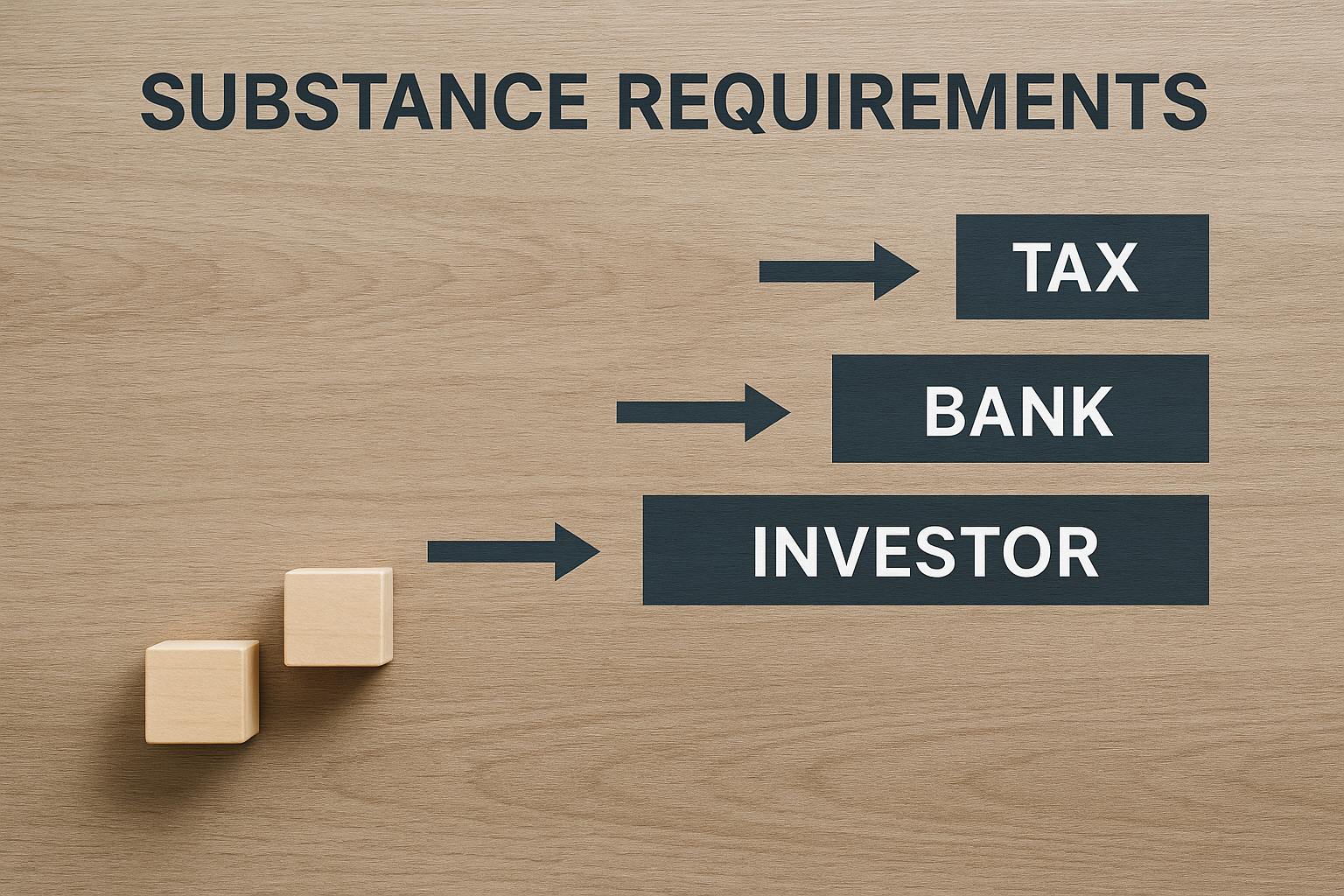
Your Cypriot holding passed a tax audit? Excellent. But that is only the first exam out of three. The second is when a bank suddenly closes your corporate account due to “insufficient substance.” The third is when an investor cancels the deal at the final stage or applies a 35% valuation discount because of issues in the corporate structure.
This is not hypothetical. In 2024, we supported Ukrainian companies with $5–15 million in revenue that faced this triple verification. Substance requirements are not about formally registering an office or hiring one employee. They are about a system in which every element — from tax reporting to bank KYC forms — speaks the same language of a real business.
In this article, we explain what tax authorities, banks, and investors actually check, and how to prepare your holding to pass all three “exams.”
What changed: from tax optimization to triple verification
Many business owners still operate in a 2015 mindset, when running through Cyprus or the UAE only required a “desk in the corner” lease and a part-time secretary. In 2025, that illusion is finally gone.
Before 2020, substance was purely a tax-planning tool. Meeting the requirements of a specific jurisdiction was enough, and the structure worked. Today, an international holding faces three independent checks:
-
Tax authorities assess where value is created and where decisions are made — to determine access to benefits and treaty relief.
-
Banks assess whether the structure is a real business or merely a funds-movement vehicle — to satisfy AML requirements.
-
Investors assess how resilient and transparent the structure is — to price transaction risk.
The key shift: these three checks use different criteria and ask different questions. What satisfies the tax authority can trigger a bank rejection. What passes bank KYC can destroy value in an investor’s eyes.
The tax lens: formulas instead of declarations
Tax authorities in the EU and the UAE have moved from document checking to analyzing the Decision Making Process. Under ATAD directives and BEPS principles, a Shell Company loses tax benefits and access to double-tax treaty relief.
Pillar 2 and the new substance mathematics
The global minimum tax (Pillar 2) turned substance from a qualitative assessment into a mathematical formula. Substance-Based Income Exclusion (SBIE) allows an exclusion from top-up tax equal to 5% of payroll costs plus 5% of the carrying value of tangible assets in each jurisdiction. Transitional rates are higher in 2025: 9.6% for payroll and 7.6% for assets.
A practical example: €100 million in payroll and tangible assets generates €16 million of excluded income at 2025 rates. For asset-heavy businesses, this can fully eliminate the top-up to the 15% minimum tax.
As of the end of 2025, 65 countries have implemented Pillar 2 legislation. 22 of 27 EU countries have implemented both the Income Inclusion Rule and a Qualified Domestic Minimum Top-up Tax. The OECD forecasts that around 90% of MNEs will be in scope of the 15% minimum tax.
What tax authorities check
-
Management qualification: does the director have the competence to manage this specific business? If you have an IT company in Cyprus but your director is a professional “mass lawyer” holding 50 mandates, that signals real management is in Ukraine.
-
Decision-making functions: where are key business decisions made (strategy, major transactions, financing, dividends)? Who signs, who approves budgets, who controls bank accounts?
-
Functional profile: what functions does the office perform? If the only employee is an accountant and there are no operational staff, the company is treated as a conduit, not a standalone entity.
-
Risk management: who decides on loans or asset acquisitions? Who actually bears commercial and financial risk? Is there documentation evidencing risk assumption?
-
Assets: what assets does the company control (IP, shares, portfolio, real estate)? Where are minutes physically signed?
Typical questions in tax requests
-
“Provide board minutes for the period … with agenda items on financing/dividends/acquisitions”
-
“Who initiated the transaction and who approved the terms? In which country were the decision-makers located?”
-
“Who has authority over the bank account? Where are the signatories located?”
-
“Describe the company’s functions in the group. Which employees perform these functions? Provide employment contracts”
-
“Substantiate the business rationale for intercompany payments and provide the TP logic”
Case from 2024 practice
A Ukrainian equipment manufacturer with a Cypriot holding received a request from local tax authorities. The reason: the company declared management of EU assets, but all strategic decisions were made in Ukraine. A formal Cyprus office with one employee did not help: assessments totaled €4.3 million plus penalties.
Risk signals for tax authorities
-
Directors serving on boards of more than 4 unrelated companies
-
Virtual office instead of physical presence
-
No local bank accounts
-
Decisions made under instructions from another jurisdiction
-
More than 65% of income from passive sources (dividends, interest, royalties)
-
Misalignment of functions and assets: IP held by the holding while development happens exclusively in Ukraine
Consequences of failure
-
Denial of treaty benefits
-
Application of GAAR (General Anti-Avoidance Rule)
-
Conditional withholding tax up to 25.8% (Netherlands)
-
Penalties up to 2–4% of annual turnover
-
Retroactive assessments for 3–5 years
Key jurisdiction requirements
-
Cyprus: majority of directors are Cyprus tax residents with real powers; at least one board meeting per year with physical presence; local employees registered in social insurance; a commercial office (not a virtual address); bank accounts with resident signatories. Maintenance cost: €15,000–40,000 per year.
-
Netherlands: at least 50% of board members are residents with decision-making power; at least €100,000 payroll spend for financial services companies; a fitted office for at least 24 months; accounting maintained locally; primary bank accounts in the Netherlands.
-
UAE: as of 2024, Economic Substance Regulations were abolished but migrated into the Qualifying Free Zone Person (QFZP) regime: CIGA must be performed within the Free Zone; adequate assets and qualified staff on the ground; audited financial statements are mandatory. Loss of QFZP status triggers 9% corporate tax and disqualification for 4 tax periods.
-
Luxembourg: majority of board members are Luxembourg residents; key management decisions are taken locally; at least one general meeting per year; qualified staff to oversee financial operations.
The banking lens: compliance as a continuous audit
Banks have become the strictest substance inspectors. After the 6th EU AML Directive and fintech fines in 2025, compliance officers ask questions that unsettle owners. For a bank, substance is a way to ensure the structure is not created solely to conceal the beneficial owner or enable aggressive tax planning.
The new EU AML package: what changed
The EU AML package published on 19 June 2024 is the biggest regulatory reform in a decade. Regulation (EU) 2024/1624 creates a Single Rulebook, directly applicable in all member states from 10 July 2027. The EU AML Authority (AMLA), headquartered in Frankfurt, started operating on 1 July 2025 and will directly supervise about 40 high-risk financial institutions.
The draft EBA Regulatory Technical Standards on customer due diligence (2025) explicitly defines complex ownership structures as any structure where the client and entities in the ownership chain are in different jurisdictions — even within the EU.
What banks check
-
UBO verification: who is the ultimate beneficial owner across the ownership chain? UBO identification, document verification, ongoing monitoring.
-
Source of Funds / Source of Wealth: where did the money come from? Evidence at each stage — contracts, invoices, tax documents, dividends.
-
Business rationale: why does a Ukrainian business need a Dutch holding? If the answer is only “tax,” the account will be closed. Banks want business logic: EU market access, IP holding, profit consolidation for reinvestment.
-
Local Nexus: the link to the jurisdiction. Are there local suppliers or clients? Is there a website in the local language?
-
Transaction behaviour: transaction patterns — unusual amounts, profile mismatch, pass-through activity, circular payments.
Typical questions in KYC questionnaires
-
“Describe the activity of each entity in the chain (not ‘holding’ but functions/revenue/expenses/staff)”
-
“Provide the ownership structure up to the natural person, including trusts/foundations”
-
“Provide evidence of source of funds for recent major inflows”
-
“Why do payments flow through this entity? Why this jurisdiction?”
-
“Who effectively manages the company? Where are the decision-makers located?”
-
“Any operations/counterparties in high-risk jurisdictions? Describe sanctions screening”
Case from 2025
An IT company with Ukrainian developers and a UAE holding applied to open an account in a European bank. The rejection arrived in 3 days: compliance did not see a link between operations in Ukraine and management in Dubai. The reason was the absence of local staff in the UAE and client contracts executed through the Emirati entity.
Risk signals for compliance officers
-
Ownership chains longer than 3 levels without a clear rationale
-
No physical presence in the incorporation jurisdiction
-
Mismatch between business scale and account activity
-
Pass-through payments (money in and out the same day)
-
Directors with thousands of appointments
-
Mass-registration addresses
-
Financial anomalies: millions in revenue with minimal headcount
-
Director compensation not aligned with market levels in the jurisdiction
Consequences of failure
-
Refusal to open an account
-
Closure of an existing account with 30–60 days’ notice
-
Inclusion in compliance “blacklists”
-
Inability to secure banking with other providers
-
Reporting to tax authorities
Onboarding timelines
-
Fintechs (Revolut, Wise): 24–48 hours for standard cases, 5+ days for complex structures
-
Traditional EU banks: up to 4 months according to Thomson Reuters
Important: Wise Business explicitly states the service is designed for cross-border payments, not for storing large balances. Accounts with significant balances without expected transaction patterns face enhanced scrutiny and potential closure.
The investor lens: substance as a valuation variable
PE/VC funds do not check substance for formality. They look for hidden risks that can destroy value post-deal. Investors fear “hidden tax liabilities” and treat substance as a way to reduce the probability of post-closing surprises.
Due diligence standards
ILPA Due Diligence Questionnaire 2.0 has become a de facto industry standard. Governance and substance sections cover: ownership structure including percentage holdings, vesting schedules and changes over 5 years; management org charts; key person terms and succession planning; ESG integration including tax transparency.
According to the PwC Global Investor Survey 2024, 18% of investors cite tax transparency as a key non-financial factor — nearly on par with health and safety.
Tax due diligence typically takes 1–3 months (up to 6 for complex deals) and covers 3–5 years of historical filings.
What investors check
-
Clean structure: how easily can the holding be liquidated or restructured without adverse tax consequences? No problematic jurisdictions or questionable schemes.
-
Governance: does corporate governance meet global standards? Are board meetings real, not paper-only? Evidence of decision-making and governance documentation.
-
CFC Rules: does the structure comply with controlled foreign company rules in the founder’s home country?
-
Tax & withholding exposure: WHT/BO/anti-abuse risk, contested payments/structures, the position on intercompany arrangements.
-
Bankability: investors do not want to buy an asset that banks won’t service — if KYC fails, operational resilience is questioned.
Typical questions from a DD checklist
-
“Show the resolutions approving key transactions/financing/dividends over the last 24 months”
-
“What functions does the holding perform? How is this reflected in budget/headcount/contracts?”
-
“Are there intercompany agreements plus TP logic? Who approved pricing/terms?”
-
“Where is group management actually performed? Any PoEM risk in another country?”
-
“Are all shareholders disclosed? Any hidden agreements or options?”
-
“Which jurisdictional risks can affect the exit strategy?”
Case from practice
A Ukrainian retail chain with $12 million in revenue lost a deal with a European fund in 2024. The reason: the investor found that part of the assets were formally owned by an offshore company without real substance. Valuation dropped by 35%, and negotiations stalled.
Investor deal-breakers
-
Complex/aggressive tax structures that are hard to unwind
-
No clear title to key assets (IP, real estate)
-
No transfer pricing documentation
-
Legal structures too complex to restructure
-
One director across multiple companies without succession planning
-
Hidden liabilities or litigation
-
Poor corporate documentation (articles, minutes, agreements)
Consequences
-
Valuation discount: tax risks treated as debt-like items — a 20–40% reduction
-
Escrow holdbacks: 10–20% of purchase price (9.14% on average according to the ABA)
-
Escrow duration: 12–24 months for general matters, 6–7 years for tax representations
-
TP-risk premium: 1–5% if insured via specialty tax insurance
-
Deal collapse at late stages
Comparison table: three views of substance
| Criterion | Tax authority | Bank | Investor |
|---|---|---|---|
| Main objective | Prevent tax base erosion | Exclude AML/sanctions risk | Minimize future losses and risks |
| Review focus | Decision-making, functions, assets, risks | UBO, Source of Funds/Wealth, business rationale | Clean structure, governance, tax exposure |
| Key question | Where is value created? | Is this a real business? | What risks am I buying? |
| Risk signals | Decisions made outside the jurisdiction; nominal management | Complex chains; pass-through activity; lack of physical presence | Hidden liabilities; misalignment of structure and activity |
| Consequences | Assessments, penalties, loss of tax benefits | Account refusal/closure, funds blocking | 20–40% discount, escrow, deal rejection |
| Reaction timelines | 6–12 months after detection | 1–3 days for refusal; up to 4 months onboarding | 4–8 weeks DD; 1–3 months tax DD |
| Review cycle | Annual filings, audits over 3–5 years | Ongoing monitoring, refresh every 1–3 years | Quarterly reporting, verification at exit |
Practical recommendations: building a structure that satisfies all three
One integrated approach instead of three separate ones
The structure must simultaneously:
-
Generate sufficient substance for SBIE optimization under Pillar 2 and ATAD compliance
-
Have documentation sufficient to open and maintain a bank account
-
Provide governance that passes investor due diligence and supports exit valuation
Substance Evidence Pack: minimum checklist
For tax authorities:
-
Resident directors with real authority (not nominees)
-
Minutes indicating location and attendees
-
Local employees with adequate qualifications
-
Physical office (not a virtual address)
-
Up-to-date transfer pricing documentation
For the bank:
-
Full ownership chart up to the UBO
-
Evidence of real activity for all group entities
-
Documented source of funds/wealth
-
Consistent transaction pattern
-
Current financial statements
For investors:
-
Governance policies and board minutes for 3–5 years
-
Clean tax compliance history without material breaches
-
Succession planning for key persons
-
Ability to restructure without critical tax consequences
-
ESG integration including tax transparency
What to do now
-
Audit the existing structure across all three dimensions — not tax only
-
Document all decisions and their rationale — in case any of the three stakeholders requests evidence
-
Reassess director appointments — reduce overlap across companies
-
Prepare for the GloBE Information Return — first filings are due by 30 June 2026 for FY 2024
-
Stress-test banking onboarding — would your structure pass KYC at a new bank?
In conclusion
Substance requirements are not a checklist and not three separate checks. They are one system in which a weak link breaks the whole structure. Substance is no longer about taxes. It is about your right to operate in the international business environment: the right to open an account, the right to attract an investor, the right to rely on treaty relief.
Structures designed without triple verification face cascading failures: failing at one level creates problems at the next. Conversely, adequate substance across all three dimensions creates synergy: what convinces a bank helps convince an investor; what withstands a tax audit simplifies the exit.
The “close your eyes and hope” approach cost our clients $27 million in missed opportunities in 2024.
The question is not whether your structure will be checked. The question is who will check first — and whether you will be ready.
LigLex helps business owners and HNWIs design and maintain international structures that work across all three verification layers. We do not sell “substance packages” — we build systems where substance is the natural result of the right architecture.
Ready for an honest assessment of your current structure? We will identify vulnerabilities and build a protection roadmap.
#Substance #Compliance #BankReady #InvestorReady #EU #Liglex
Author by Lipatnikov Sergey


